
M V Subramanian says there is an imperative need for collective responsibility to tackle inflation, prices and availability of essential commodities, and not rely on inflation targeting alone.

The 6-member Monetary Policy Committee, headed by Reserve Bank of India Governor Urjit Patel, in its fifth bi-monthly review, kept the repo rate unchanged at 6 per cent and reverse repo at 5.75 per cent.
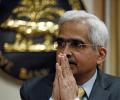
'Three external members of the first MPC are respected researchers with excellent academic background, but there is no harm in considering academicians with diverse backgrounds such as finance and labour along with economists for this body,' recommends Tamal Bandyopadhyay.

Sahil Kapoor of Edelweiss Retail Capital Market Research says that setting up a monetary policy committee should have been the first step. And the central bank could have moved towards a formal inflation targeting mechanism after the processes and data sets are in place.

The Reserve Bank of India (RBI) on Friday kept the key repo rate unchanged at 4 per cent in view of rising inflation and faint signs of economic growth amid the gradual lifting of coronavirus related countrywide lockdown.

The Reserve Bank is working on a phased implementation strategy for its own digital currency and is in the process of launching it in wholesale and retail segments in the near future, RBI Deputy Governor T Rabi Sankar said on Thursday. He said the idea of Central Bank Digital Currency (CBDC) is ripe, and many central banks in the world are working towards it. Sankar further said CBDC is needed to protect consumers from the "frightening level of volatility" seen in some of the virtual currencies which have no sovereign backing.
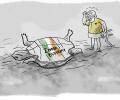
The International Monetary Fund (IMF) on Tuesday slashed India's growth forecast for 2022-23 (FY23) by 80 basis points to 7.4 per cent, citing less favourable external conditions and rapid policy tightening by the central bank. In its update to the April World Economic Outlook, the IMF said that though a global recession in 2022 was ruled out with a growth estimate of 3.2 per cent, the balance of risks was squarely to the downside, driven by a wide range of factors that could adversely affect the global economic performance. "The risk of recession is particularly prominent in 2023, when in several economies growth is expected to bottom out, household savings accumulated during the pandemic will have declined, and even small shocks could cause economies to stall.
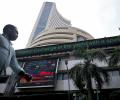
RBI policy, macro data, company earnings to decide market course this week: Experts

Global trends, macroeconomic data, and the outcome of the US Fed policy meeting are the major factors that will drive the movement in the domestic equity markets this week, analysts said. "In the upcoming data-centric week, the focus will be on crucial releases, including inflation data from India and the US. "Indian inflation is expected to rise, while US inflation will remain steady.

The government hopes the latest action will lead to banks also lowering the cost of borrowing for corporate and individual borrowers.
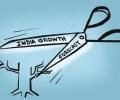
The biggest risk to India's growth outlook is an escalation of geopolitical tensions, especially if these tensions spread to the Asian region, RBI Monetary Policy Committee (MPC) member Jayanth R Varma said on Wednesday. Varma, in an interview to PTI, said that inflation and inflationary expectations appear to be moderating and high inflation will certainly not become the 'norm' in the country. He is cautiously optimistic about the Indian economy as after the pandemic abated, consumption demand has begun to recover though the recovery is uneven across sectors and industries.
The RBI is not statutorily independent from the government but has long enjoyed wide latitude

RBI governor is seen succeeding International Monetary Fund (IMF) chief executive officer, Christine Lagarde, next year.
All-out efforts are needed to mitigate the adverse impact of the Covid-19 pandemic, and the RBI will use any instrument necessary to revive growth and preserve financial stability, according to the minutes of the central bank's policy meeting.

A lot depends upon the composition of the monetary policy committee.

While the economy seems to be on a firm growth path, the fight against inflation is not over yet. Shaktikanta Das seems to be in no hurry. After playing well through a five-year Test match, he doesn't want to get out hit wicket, observes Tamal Bandyopadhyay.
Das favoured shifting the stance of monetary policy from neutral to accommodative to send a clear signal, indicating that more measures could be taken in the near future to boost growth.
Market participants must appreciate that staying cautious is a virtue for central bankers and should not expect a sudden reversal in the formal monetary policy stance.

The Reserve Bank's rate-setting panel will start its 3-day deliberations on Wednesday amid expectations of yet another rate hike of 50 basis points to check high inflation, in line with similar actions taken by other major central banks, including the US Fed. Based on the recommendations of the Monetary Policy Committee (MPC), the RBI had effected 50 basis points increase in repo rate each in June and August after raising the short-term lending rate by 40 basis points in an off-cycle decision in May. The MPC, headed by RBI Governor Shaktikanta Das, is scheduled to meet during September 28-30.

The Sensex jumped 412.23 points on Friday, braving heavy volatility during the day, amid the Reserve Bank of India maintaining status quo on the benchmark lending rate and buying in index heavyweights Reliance Industries Limited and ITC. The BSE Sensex climbed 412.23 points or 0.70 per cent to settle at 59,447.18. During the day, the benchmark hit a high of 59,654.44 and a low 58,876.36. The Nifty also gained 144.80 points or 0.82 per cent to finish at 17,784.35.

In the current fiscal so far, retail inflation stabilised around 5 per cent, while wholesale price-based inflation averaged around 2.9 per cent during April-December.
However, RBI would continue to nudge banks to cut lending rates

Tomorrow's review could also turn out be the last policy anchored by Rajan if the proposed Monetary Policy Committee (MPC) is put in place before the next review due on August 9.

Rajan said that even though inflation has breached the 6 per cent mark as against the RBI target of getting it down to 5 per cent by March 2017, the price rise scenario will ebb in future

India's services sector activity eased in August but growth rates for new orders remain elevated, as services firms indicated the sharpest upturn in new export business which acted as a catalyst for firms to expand their workforces as well as output, a monthly survey said on Tuesday. Despite falling from 62.3 in July to 60.1 in August, the seasonally adjusted S&P Global India Services PMI Business Activity Index indicated one of the strongest increases in output seen since mid-2010. For the 25th straight month, the headline figure was above the neutral 50 threshold.

Inflation in the 'fuel and power' basket in December slumped to 8.38 per cent, nearly half of 16.28 per cent.
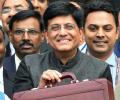
Goyal said India has been recognised as brightest spot in the world in last five years.

As COVID-19 infections spike in the country resulting in restrictions in various states and impacting the fragile recovery, many economists are expecting RBI to delay the policy normalisation move, which is expected in the February review. The country has reported a single-day rise of 58,097 new Covid-19 cases as of Wednesday morning--the highest in around 199 days -- of which 2,135 are Omicron cases and later in the day, the first confirmed Omicron-related death has also been reported. Maharashtra recorded the maximum number of 653 Omicron cases followed by Delhi at 464, Kerala 185, Rajasthan 174, Gujarat 154 and Tamil Nadu 121 cases, taking the total tally of cases to 3,50,18,358.

The finance ministry expects a broad-based moderation in inflationary pressures on the back of an anticipated reduction in food prices as a result of the uptick in summer sowing. The retail inflation rate remained stubbornly clung to the 5 per cent mark in seven of the past eight months. "Core inflation is trending downwards, indicating a broad-based moderation in price pressures... Driven by strong domestic growth and benign global commodity prices, core inflation is declining continuously.
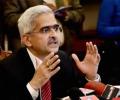
Amid prolonged uncertainty, continued policy support will be crucial for sustained economic recovery from the coronavirus pandemic, Reserve Bank Governor Shaktikanta Das said at the recent meeting of the Monetary Policy Committee. "In this period of prolonged uncertainty, it would be wise to remain agile and respond in a gradual, calibrated and well telegraphed manner to the emerging challenges," opined Das, according to the minutes of the MPC meeting released by the Reserve Bank on Thursday. Observing that economic recovery from the pandemic remains incomplete and uneven, he said, "continued support from various policies remains crucial for a sustained recovery." The governor said the renewed surge in international crude oil prices, however, requires close monitoring.

Market breadth depicted gains with 1,476 advances over 1,403 declines on the BSE. 140 stocks remained unchanged.
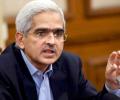
Reserve Bank of India (RBI) Governor Shaktikanta Das had stumped the market in the previous two policies - in August and in October - first with action and then with words. In August, it was the introduction of an incremental cash reserve ratio (I-CRR) to take out excess liquidity, which took the markets by surprise. In October, there was no action. Rather, what is known as "open mouth operation", Das' comment that the central bank might conduct open market operations (OMOs) by selling bonds tempered the euphoria in the bond markets after JP Morgan's inclusion of India in its Emerging Market Bond Index.

India's manufacturing sector activities witnessed the strongest rate of growth in three months in July amid improved demand conditions and easing of some local COVID-19 restrictions, a monthly survey said on Monday. The seasonally adjusted IHS Markit India Manufacturing Purchasing Managers' Index (PMI) rose from 48.1 in June to 55.3 in July, pointing to the strongest rate of growth in three months. In PMI parlance, a print above 50 means expansion while a score below 50 denotes contraction.

RBI targets to keep inflation at 4 per cent, (+/- 2 per cent), and its rise beyond this comfort zone will put pressure on the central bank to hike rates.
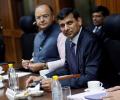
Balance is needed in selecting members for the proposed monetary policy committee, says Abheek Barua.

Both the indices closed at five-month highs, led by financial services, IT and metal stocks, amid persistent foreign fund inflows.

'Banks are being encouraged to lend instead of parking their resources with the RBI and earn risk-free interest income,' points out Tamal Bandyopadhyay.

Probably 35 bps. There could be even an encore in February 2023 to take the policy rate to 6.5% before the financial year ends, predicts Tamal Bandyopadhyay.

If true then it would be a major disruption in the industry

India's services sector growth eased to a three-month low in June but service providers continued to signal positive demand trends, which resulted in a stronger increase in new business volumes and further job creation, a monthly survey said on Wednesday. The seasonally adjusted S&P Global India Services PMI Business Activity Index fell from 61.2 in May to 58.5 in June. Despite falling from May, the latest figure was consistent with a sharp pace of growth.
